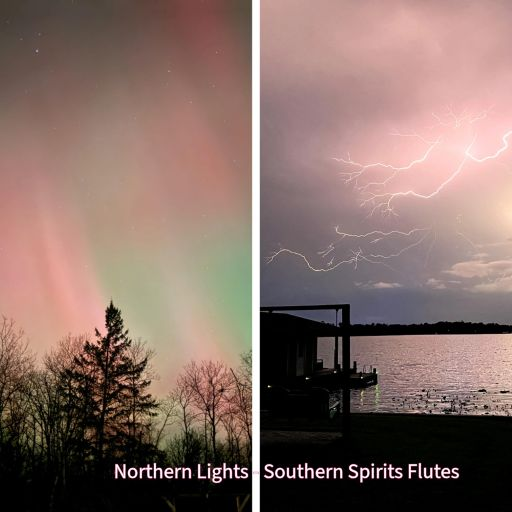
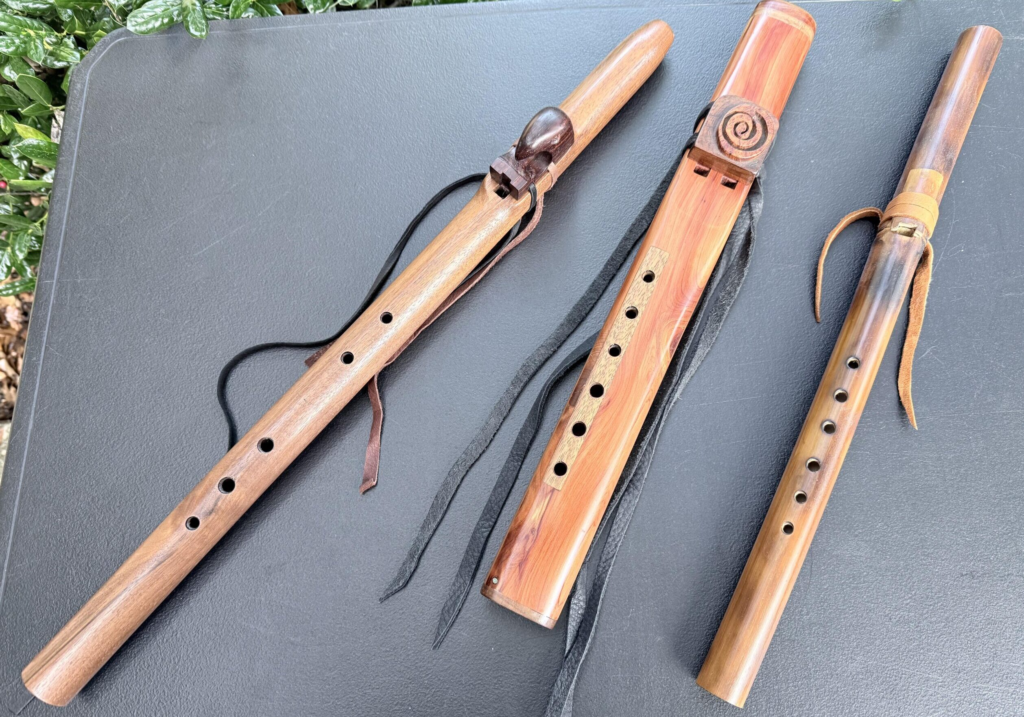
Examples of flutes I’ve created. None of these are available for purchase. But I hope they demonstrate my creative sensibilities and design choices. It may be worth noticing, I don’t care to repeat designs very often if I can help it.
Collaborative Projects
Lumbee tribe recognition tribute flutes
“The Lumbee, also known as People of the Dark Water, are a mixed-race Indigenous peoples of the Americas who comprise the federally recognized Lumbee Tribe of North Carolina. … The Lumbee take their name from the Lumber River, which winds through Robeson County. Pembroke, North Carolina, in Robeson County, is their economic, cultural, and political center. On December 18, 2025, the Lumbee Fairness Act was signed into law, making them the 575th federally recognized tribe.” [Wikipedia]
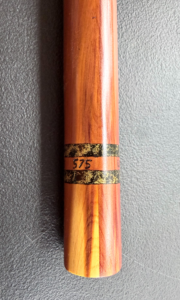
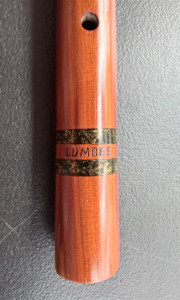
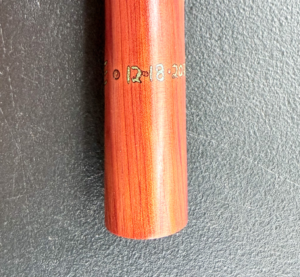
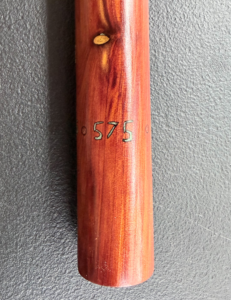
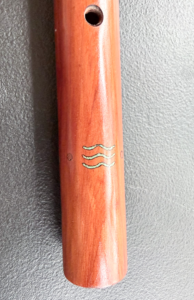
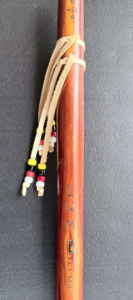
In response to a commission by a tribal member, I set out to craft tribute flutes composed primarily of Eastern Red Cedar. With the phrase “People of the Dark Waters” in my mind, I incorporated curly Black Walnut harvested from a friend’s property in eastern Wisconsin into the tenon-construction mouthpieces and blocks. Both blocks have three carved, wavy lines representing a symbol for a river. Both flutes include the tribal name (Lumbee), the number 575 representing the 575th federally recognized tribe and 12.18.2025 which is when the tribal recognition became a federal law. Crow beads on the block laces represent colors used on the Lumbee Tribal Seal.
A faceted Aquamarine gemstone is embedded in both flute bodies. Both flutes were finished using multiple coats of polymerized Tung Oil (sealer and high lustre viscosity) and maroon shellac before being hand rubbed to a final finish using pumice and rottenstone.
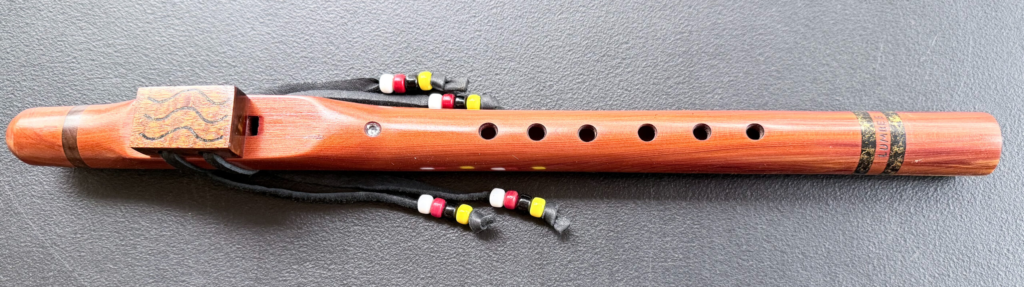
Flute 454 is made of Eastern Red Cedar and has a curly Black Walnut and Eastern Red Cedar mouthpiece. 3/4″ bore; Key: A4. The flute is 17 9/16″ long.
The block has a thin pommelle Sapele layer containing a carved river symbol (three wavy lines with brass and Pennsylvania Jet inlay) on curly Black Walnut (Wisconsin) / Eastern Red Cedar.
The body of the flute is decorated with twin bands below the finger holes. They are filled with brass / Pennsylvania Jet inlay representing “Dark Waters.” Lumbee, the date12.18.2025 and number 575 are wood burned between the inlay bands. A faceted Aquamarine stone is inset below the nest. Approximately 6mm wide at the collar, the stone is estimated to be nearly one carat.
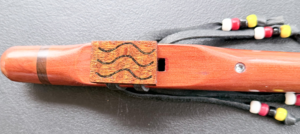
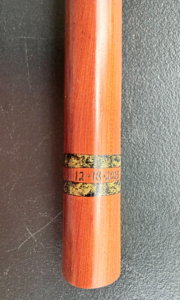
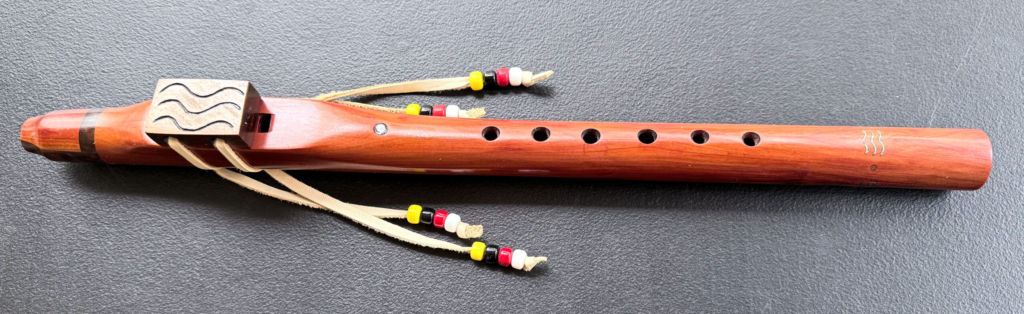
Flute 456 is also an Eastern Red Cedar flute. It has a compound curly Black Walnut and Eastern Red Cedar mouthpiece. 3/4″ bore; Key: A4. The flute is 17 3/4″ long.
The block features a thin Dogwood (Gainesville, FL) layer with a carved river symbol (three wavy lines) which reveal the underlying Black Walnut (Wisconsin) on Eastern Red Cedar.
The Eastern Red Cedar used to make this flute came from a tree which grew in the Osceola National Forest near Lake City, Florida. When the tree fell, Mr. Ray Macatee was invited to retrieve it by representatives of the U.S. Forest Service.
Ray was a veteran of the United States Marine Corps and worked as a machinist and welder. He was the designated Native American Chaplain for the Florida Prison system. He was also authorized to bring drums into the prison for drum circle and prayer services. To the best of my knowledge, this was an extraordinary privilege. Outside objects are not normally allowed to be brought into a prison by any visitors due to risks posed by contraband.
He was a member of the Cherokee of Georgia; Rose Creek Band; and was a designated “Chief” of the Alligator Warrior Festival. He was authorized by the Florida Fish and Wildlife Conservation Commission (FWC) to possess birds of prey and other protected species.
Ray founded and ran a non-profit called “Scrap to Music” which donated musical instruments to students who could not afford them. He also acquired used instruments (often refurbished by the owner of Hoggtowne Music in Gainesville, FL) and sent them to under-privileged children world-wide so students could learn and enjoy the art of music.
I’m confident very few flutes have ever been made with this wood. The first flute I made with it was eventually owned by and played overseas by Ray’s Marine grandson who served in Iraq and Afghanistan.
Sleeping Beauty Turquoise and Pipestone inlay were used for the numbers and letters used in this flute design. This Aquamarine faceted gemstone is also approximately one carat.
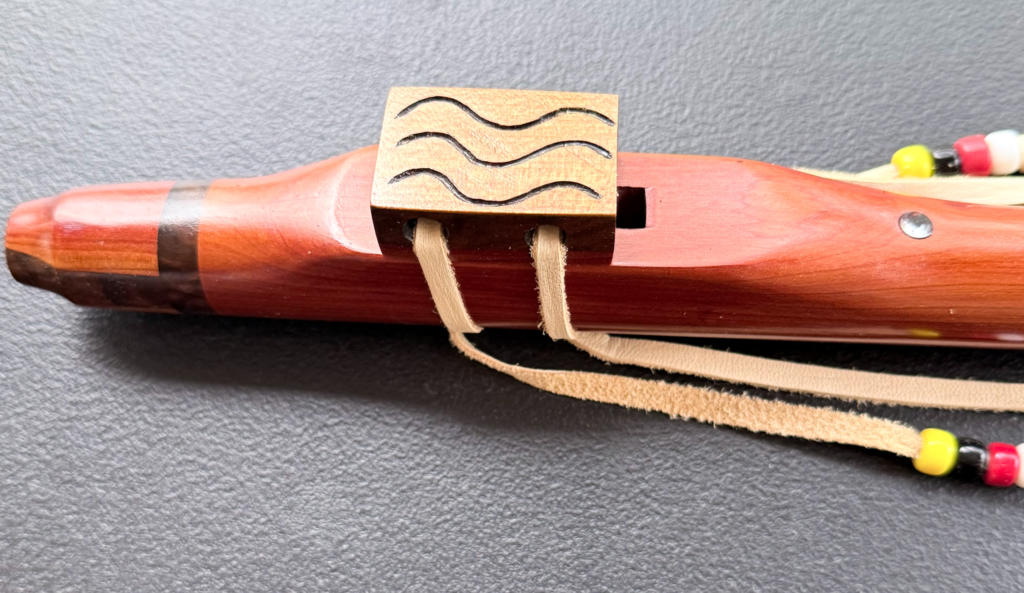
Lightning-struck Eastern Red Cedar, Pensacola, FL area
An Eastern Red Cedar tree near Pensacola was killed by a lightning strike. The family who owned the property saved several quartered trunk sections of the tree using a chainsaw. After 5 years or so, they brought the wood to Musical Echoes with the intention of asking a flute maker to create a flute or two using butterfly as a deign motif. I was able to make three 7/8″-bore flutes. Two were long enough to be tuned as G4. A shorter one was tuned as an A4. Prior to working with this wood, I’d never encountered any discernible figure in Eastern Red Cedar. Figure is a term used to describe natural patterns in wood usually caused by the grain, the cut (e.g., quartersawn) or other natural properties. In this instance I strongly suspect, the effect was caused by the lightning.
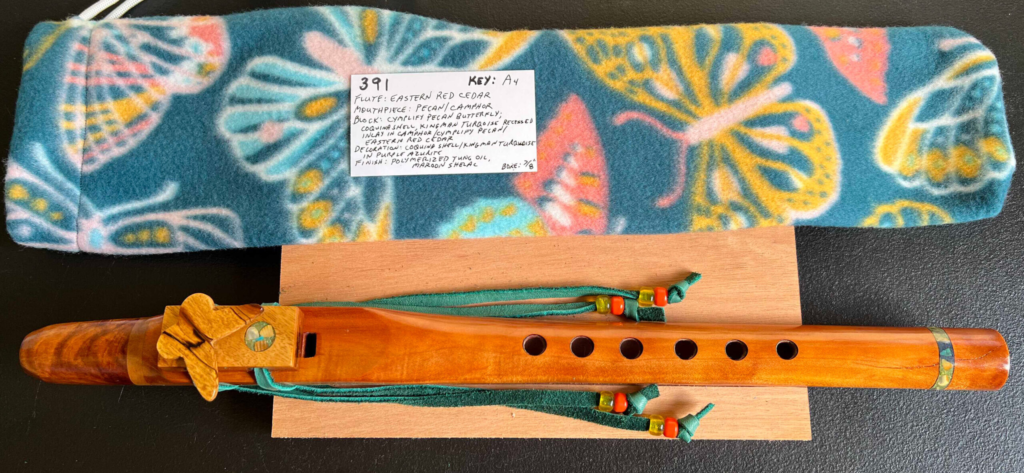
Flute 391 is lightning-struck Eastern Red Cedar with a Pecan / Camphor mouthpiece. 7/8″ bore; Key: A4. The flute is 17″ long.
The block has a Pecan butterfly on Black Walnut behind a recessed inlay of Coquina shell on a bed of Kingman Turquoise in Camphor / Pecan / Eastern Red Cedar
The body of the flute is decorated with an inlay ring at bore end. St. Augustine Coquina shells are in a Kingman Turquoise matrix. A single Kingman nugget in purple Azurite is situated inline with the finger holes.
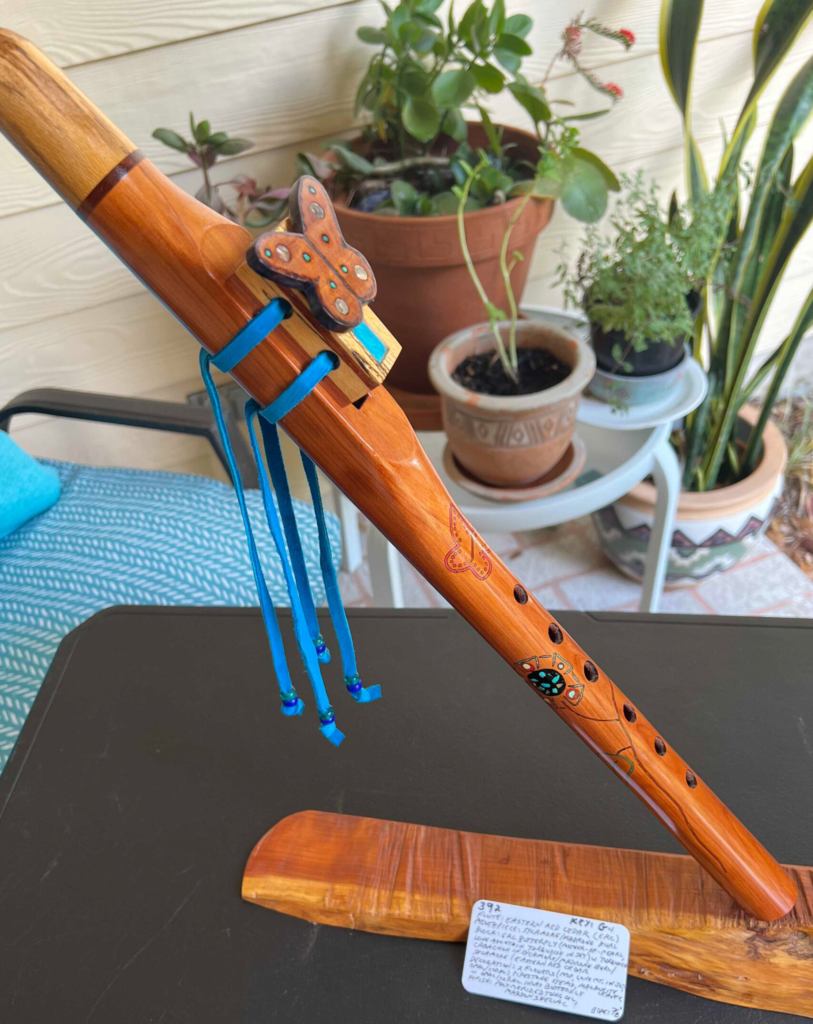
Flute 392 is 20 3/16″ long lightning-struck Eastern Red Cedar with a spalted Sycamore and Madrone burl mouthpiece. 7/8″ bore; Key: G4.
The block features an Eastern Red Cedar butterfly elevated on Black Walnut above Camphor with an embedded Turquoise cabochon. Madrone burl / Camphor / Eastern Red Cedar layers form the base. The butterfly’s wings are decorated with four Mother-of-Pearl inlay dots and six Lone Mountain Turquoise nuggets in Pennsylvania Jet. With wood burned accents.
The body of the flute is decorated with an inlay butterfly below the nest (common Opal and red Coral). Two flowers appear on either side of the flute. The flower head on the right has Mother-of-Pearl and Lone Mountain Turquoise in Pennsylvania Jet. Another on the left side of the flute is Mother-of-Pearl and Lone Mountain Turquoise in Opal and red Coral. Blossom leaves feature Mother-of-Pearl and Turquoise nuggets in red Coral. The stems are Minnesota Pipestone with fragments of Mother-of-Pearl. The two leaves are Malachite stone inlay.
The single flute stand shown in this image was made using a bit of the lightning-struck Eastern Red Cedar.
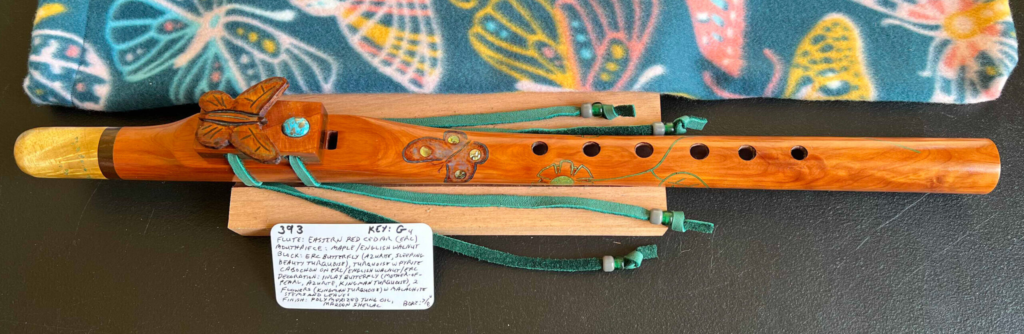
Flute 393 is lightning-struck Eastern Red Cedar with a Maple / English Walnut mouthpiece. 7/8″ bore; Key: G4. About 20 7/8″ long.
The block has an Eastern Red Cedar butterfly (purple Azurite wing veins, Sleeping Beauty Turquoise body, wood burned and PrismaColor (Peacock Blue, Ultramarine Blue, True Blue) accents) on Black Walnut behind a Turquoise with Pyrite cabochon on quartersawn Eastern Red Cedar / English Walnut / Eastern Red Cedar
An inlay butterfly positioned below the nest (Blue / purple Azurite with mother of pearl wings, Kingman body and four Mother-of-Pearl inlay dots in wings) appears over two flowers (Kingman Turquoise blossoms, Malachite stems and two leaves)
Black Cherry, Tama, Iowa area
Every now and again – if one is especially fortunate, opportunities sometimes come along to make a difference using materials that are meaningful in someone’s life. The following flutes represent the culmination of a collaborative project involving a new friend.
The story behind the board used to create the next few flutes … “This piece of Cherry wood was cut and milled from a tree located in the vicinity of Tama, Iowa – not far from the tribal lands of the Meswaki Nation. In about 1976, with cherry from this tree, I had a charming cherry railing built in my first home. This one last beautiful piece of cherry wood was the only board not used in the construction. I loved this piece – I kept it – I knew that one day it would turn into something “special”. After a relatively short stay with my parents, this piece has traveled with me most of my adult life – passing through Iowa, Illinois to Virginia, South Carolina, Saint Simons Island, GA and finally to Florida – at least 7 moves more than 40 years on the journey. With Dan’s help, its beauty and its destiny are now clearly made manifest.”
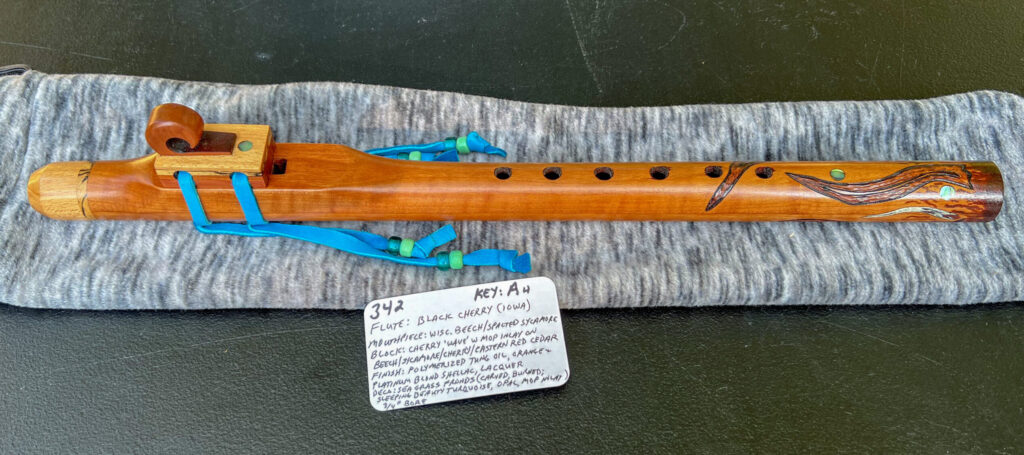
Flute 342 is Iowa Black Cherry. The tenon mouthpiece is Wisconsin Beech and spalted Sycamore. Tuned as an A4, this 3/4″-bore flute is about 17 7/8″ long. The block features a Cherry wave (aged interior) with a Mother-of-Pearl (MOP) inlay dot on Beech / Sycamore / Cherry / Eastern Red Cedar. Decorative elements on this flute include wood burned and carved sea grass fronds reaching from the artificially aged bore end to the lower finger holes. Three smaller fronds are inlaid around the flute using Sleeping Beauty Turquoise and common Opal (mixed with white PearlEx). Three 1/4″ Mother-of-Pearl inlay represent rising bubbles and match the dot on the block.
All of these flutes are finished using polymerized Tung Oil, Platinum Blond Shellac and acrylic Lacquer before being hand-rubbed using pumice and rottenstone.
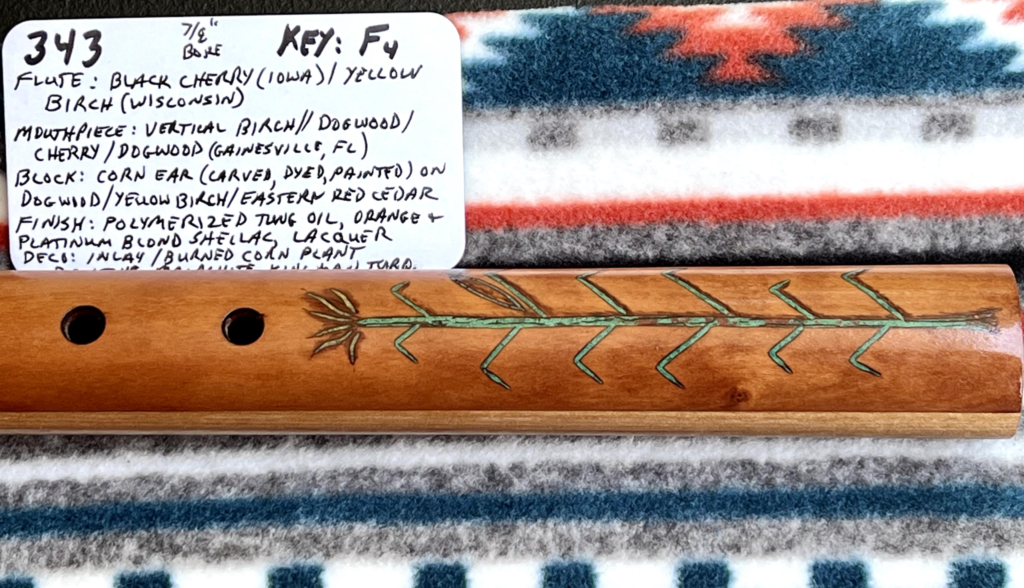
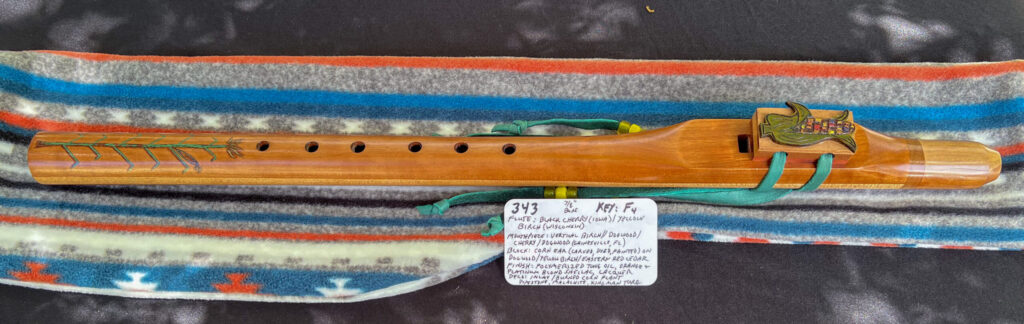
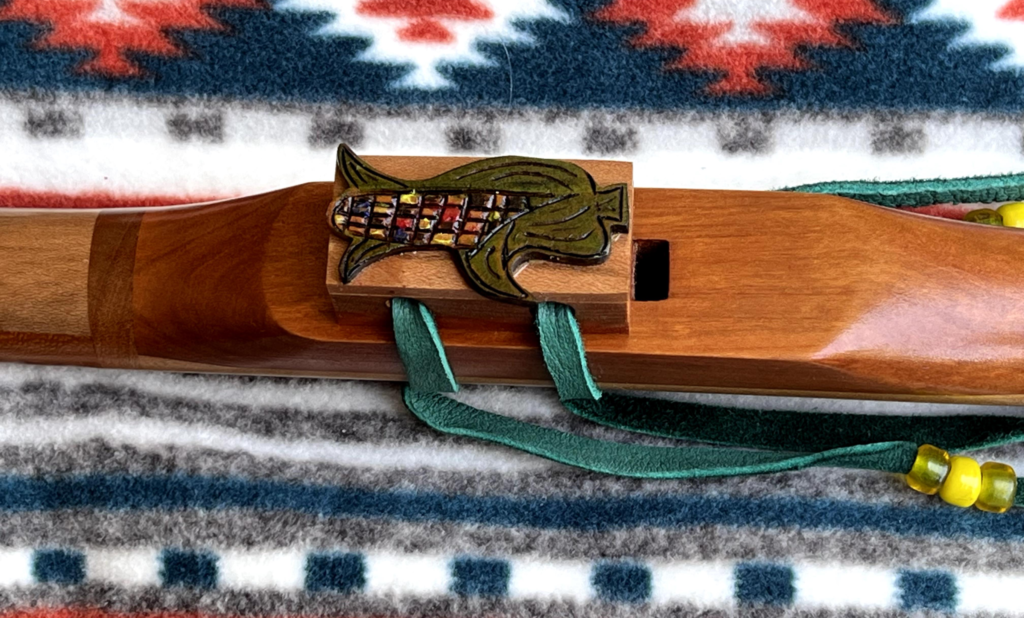
Flute 343 is a 7/8″-bore flute tuned to the key of F4. It is about 22 3/16″ long. The flute is constructed of Iowa Black Cherry paired with Wisconsin Yellow Birch. The composition mouthpiece includes Yellow Birch (vertical) // Dogwood / Cherry / Dogwood. The Dogwood came from a tree which grew in our daughter’s front yard. The Yellow Birch grew at a friend’s property in eastern Wisconsin. The block has a Corn ear carving (Cherry with Yellow/Cyan aniline dye and painted/wood burned kernels) on a base of Dogwood / Yellow Birch / Eastern Red Cedar.
Using corn as a theme came about in part because it seems we both spent time working in Iowa corn fields as boys. De-tasseling may be a necessary task, but it is an especially grueling job. Especially for small people who must gently bend the corn stalk to reach the tassel. Summer temperatures and humidity are usually high in Iowa and there isn’t much breeze making its way between rows of tall corn plants. Memories of this work are still vividly fresh many, many decades later.
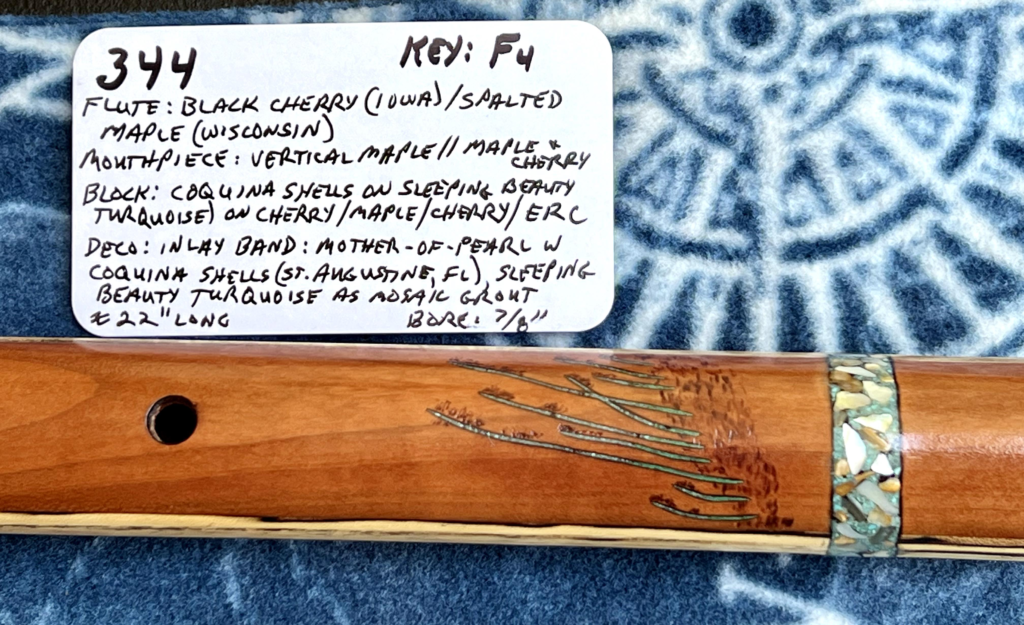
Flute 344 is Iowa Black Cherry with a Wisconsin spalted Maple center. The mouthpiece is spalted Maple (vertical) // Maple / Cherry / Maple / Cherry / Maple. The block has an inlay composed of Coquina on Sleeping Beauty Turquoise in Cherry / Maple / Cherry / Eastern Red Cedar. Decorations include an inlay band above the flute’s foot – Mother-of-Pearl with St. Augustine, FL Coquina. Sleeping Beauty Turquoise as mosaic grout. Sand dune plants – sea oats (Malachite, Sleeping Beauty Turquoise with wood burned accents) appear on top and bottom sides.
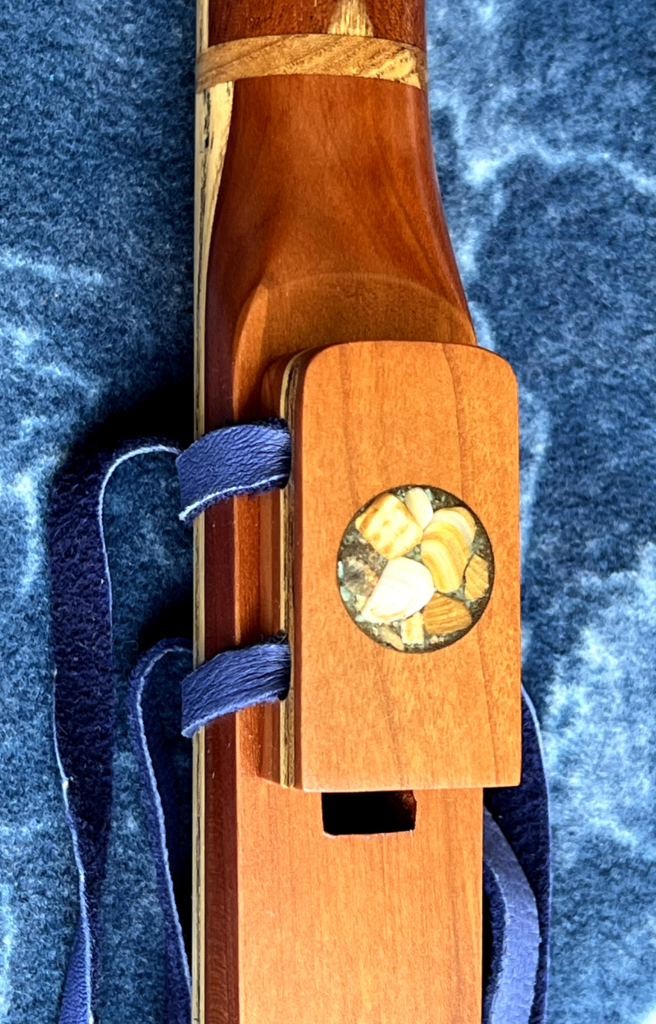
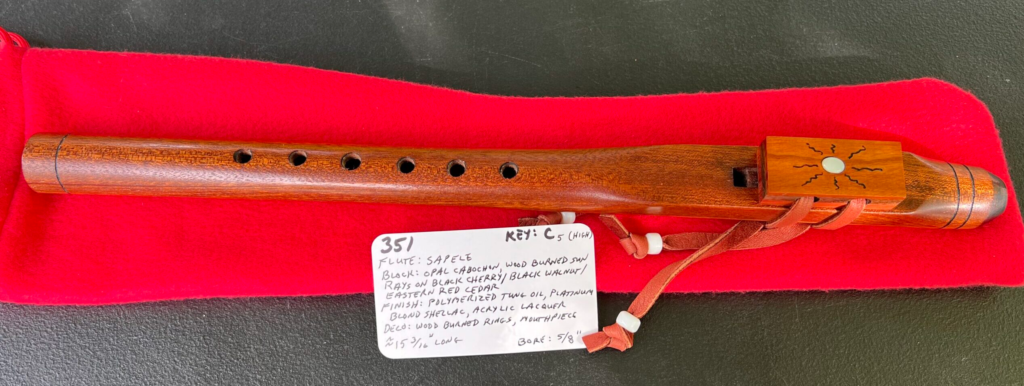
This high-pitched (C5) Sapele flute was created when I mistakenly thought I was working with another piece of the Iowa Cherry. It has a 5/8″ bore and is about 15 3/16″ long. The block has an Opal cabochon with wood burned sun rays on Cherry / Black Walnut / Eastern Red Cedar. A simulated mouthpiece and end cap are wood burned.
Wisconsin Beech and Ash
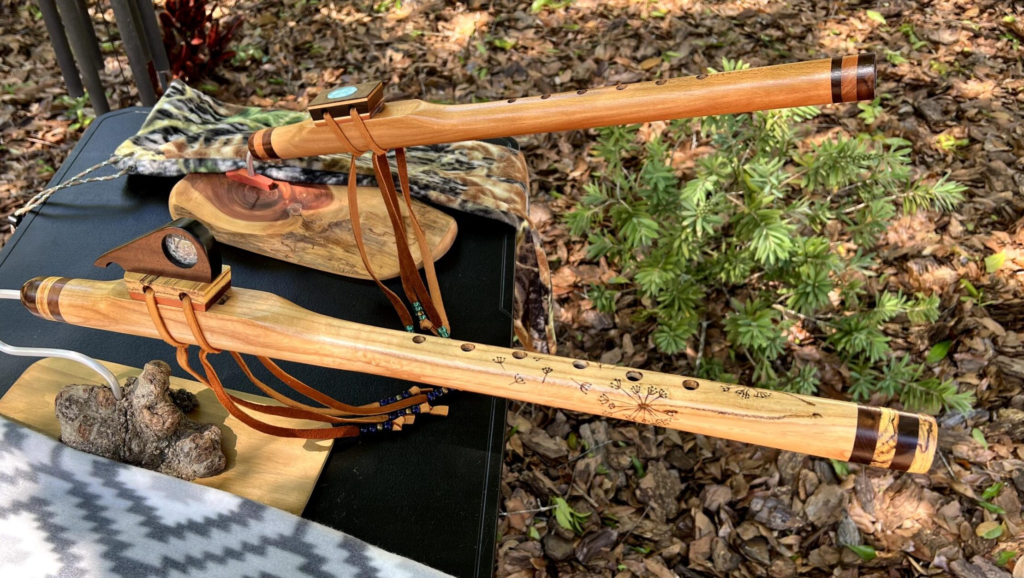
A good friend in Wisconsin surprised me by asking what I thought of using Ash to make a flute. As is my habit, I immediately answered without stopping to wonder why he might have posed the question. Fortunately, after telling him I thought Ash is generally a boring looking wood, he continued our conversation long enough to explain his idea. While clearing land for a new home he was building, he’d had a number of trees felled, milled into lumber and kiln dried. The species included Beech, Yellow Birch, Black Walnut and spalted Maple. He’d also had an Ash tree taken down from his daughter’s property. He wanted to have two flutes made using this wood.
I was thrilled with the prospect and eagerly embraced the opportunity to collaborate with someone so experienced in design.
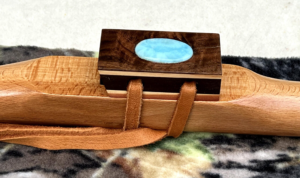
The body of Flute 271 is Wisconsin Beech. The tenon mouthpiece is Black Walnut / Yellow Birch / Black Walnut (thin) and the tenon-construction end cap is Black Walnut / Yellow Birch / Black Walnut. The block features a beautiful Larimar cabochon (horizontal) with the top standing slightly proud (above) California Claro Walnut burl (VERY thin!) on Beech / Wisc. Black Walnut / Eastern Red Cedar. There is a 15 degree forward leaning slope which aids the tuning as an F4 flute. It has a 7/8″-diameter bore and is about 22 1/4″ long.
Following a discussion about the potential dimensions of the block, my friend acquired the Larimar cabochon. Larimar (compact Pectolite) describes a rare blue variety of Pectolite found only in Dominican Republic. It has become a very popular gemstone. My challenge was finding a method for securing this specific stone with the top very slightly higher than the surrounding wood without any obvious gap. I was pleased with the effect achieved.
Flute 272 is also a 7/8″-bore flute tuned to the key of F4. It is about 22 3/4″ long. The flute is constructed of Wisconsin Ash. The mouthpiece is made of Black Walnut / spalted Maple / Black Walnut (thin). The tenon end cap is Black Walnut / spalted Maple / Black Walnut. The block features a Moss Agate (vertical) in a Wisconsin Black Walnut (ebonized upper surface) figure mounted on spalted Maple / Eastern Red Cedar. There is a 7 degree forward leaning slope on the block.
The decoration on this flute contains two spent dandelions which are wood burned from the bore end upward. Seeds (inlaid Azurite) attached to the fuzzy structure called a ‘pappus,’ drift upwards in random orientations.
Both flutes were finished using polymerized Tung Oil and Platinum Blond Shellac before being hand-rubbed using pumice and rottenstone.
The songs below were recorded by my daughter.
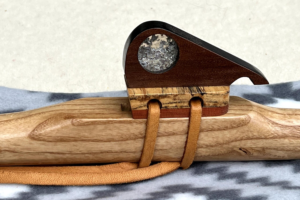
Legacy Leonard McGann-voiced drone
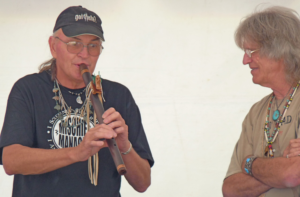
For many years, Leonard McGann (Lone Crow Flutes) actively participated in the Musical Echoes Native American Flute Festival. He commonly served as a judge for flute making competitions. He was a beloved character and held a wealth of knowledge. Without any doubt he influenced and guided many accomplished flute makers. His passing was deeply felt in the communities of flute players and flute makers.
My first interaction with Leonard happened after awards for the flute making competition had been announced. Mind you, I had been warned not to ask for Leonard’s critique of my work if I wasn’t prepared to hear the unvarnished truth. And so it was. Over the course of a couple of hours – while he would have been well served by focusing his attention on selling his flutes, Leonard and a succession of other flute makers weighed in with comments about the few things I’d done right and the many things I could have done better. There was room for a LOT of improvement. But advice offered that afternoon was uniformly heartfelt and was presented in a way that inspired me to get to work on the next (improved) flute as soon as I could.
Flute vendors and exhibitors at events like this typically donate items to be sold by festival organizers at a silent auction to help fund future events. One year Leonard offered up two partially finished flute blanks for an auction. I was determined to win bids for both flute blanks which had been “voiced” by Leonard in 2011. One single barrel and one drone flute. Voicing means they were completed to the point where the fundamental note had been tuned. No finger holes had been added yet and of course no finish had been applied. The block was shaped but that wasn’t completed either.
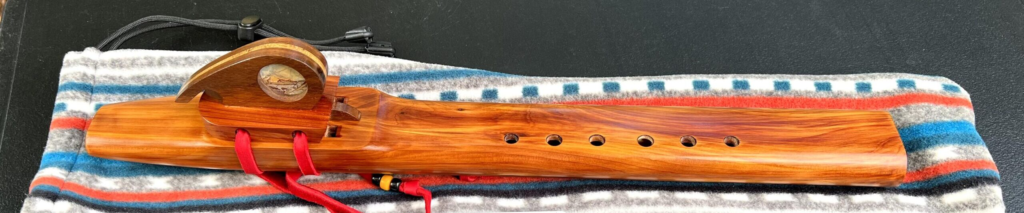
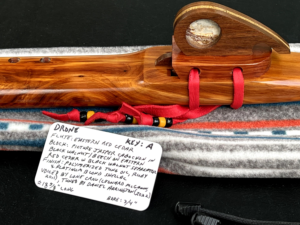
In 2023, after looking at the drone blank sitting on a shelf in my home for years while thinking of Leonard, I finally decided it needed to become a finished flute. The body and block base made by Leonard are beautiful Eastern Red Cedar. The block features a Picture Jasper cabochon encased in a Wisconsin Black Walnut and Beech figure mounted on the double width Eastern Red Cedar with a Black Walnut separator made by Leonard. He incorporated a 25 degree forward leaning slope which influenced the tuning as an A4 flute. It has 3/4″-diameter bores and is about 18 5/8″ long. I made this as a six-hole flute. Rather than adding some kind of decoration, I decided to let the beauty of this wood shine through all on its own.
It was finished using polymerized Tung Oil and Ruby Shellac. Instead of assigning a flute number to this flute, it has both of our names inscribed as makers.
My Designs
American Elm, flute 250
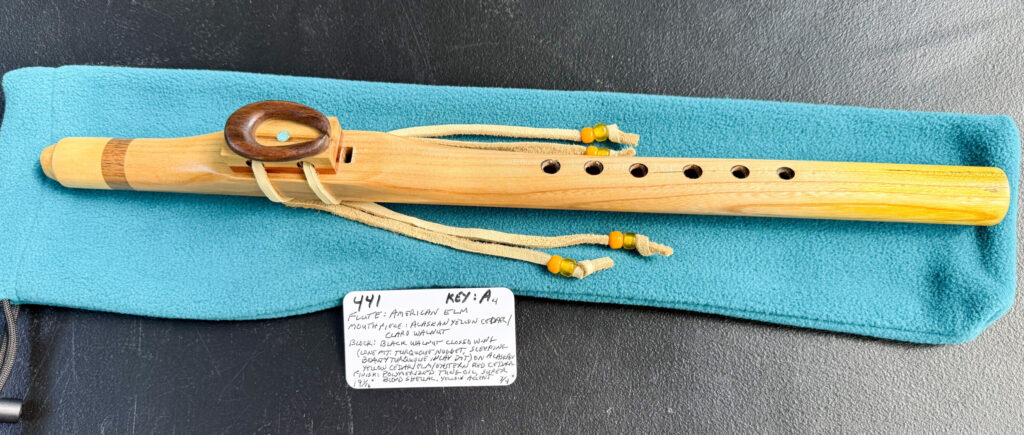
Flute #441 – American Elm with a yellow aniline dye accent on the bore end. The mouthpiece is Alaskan Yellow Cedar / American Elm / Eastern Red Cedar. Black Walnut wings surrounding an inlay dot (Lone Mountain nugget in Sleeping Beauty turquoise) on Alaskan Yellow Cedar / American Elm / Eastern Red Cedar as the block. Tuned as an A4, this flute has a 3/4″ bore and is about 19 1/8″ long.
Physician Flute, flute 250
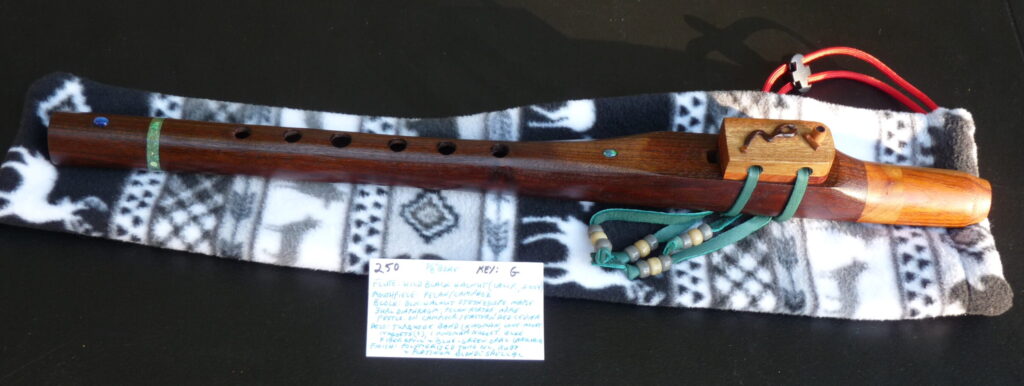
Wild Black Walnut (California, cut in April 2004) with a Pecan / Camphor mouthpiece. The block has a Black Walnut stethoscope (Maple burl diaphragm) and a Pecan mortar with an Apple pestle. On Camphor and Eastern Red Cedar. The flute is decorated with an inlay band at the foot – Kingman mine Turquoise with three Lone Mountain Turquoise nuggets and one Kingman chip. A blue fiber-optic plastic cabochon is positioned below the inlay band. A blue-green Opal cabochon is inset below the nest.
English Yew, flute 412
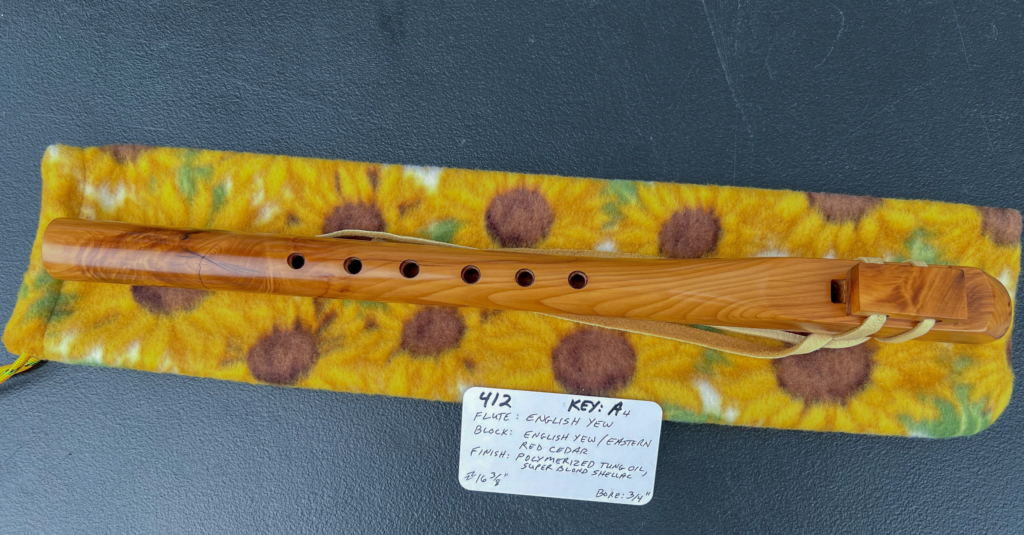
English Yew. Commonly used for making archery bows, this wood is just delightful looking. Simple but elegant. Flute 412 is a 3/4″-bore, A4 flute which is about 16 3/8″ long. This is an example of a basic flute made without adding a separate piece of wood as a mouthpiece and without adding distinctive decorations.
Black Mesquite, flute 382
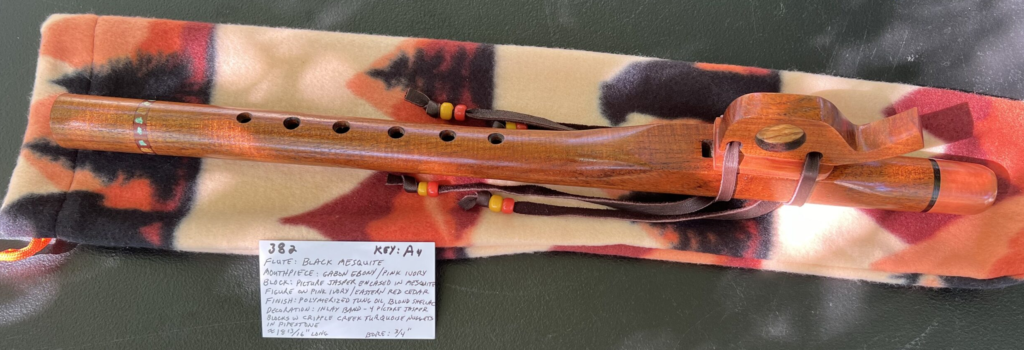
Flute 382 is Black Mesquite with a Gabon Ebony / Pink Ivory / Ebony tenon mouthpiece. Tuned as an A4, this flute has a 3/4″ bore and is about 18 13/16″ long. The inlay ring at the bore end has four Picture Jasper mosaic blocks inter-spaced with Cripple Creek Turquoise nuggets (Colorado, USA) surrounded by Pipestone.
The block features Picture Jasper encased in a Black Mesquite figure on thin Pink Ivory / Eastern Red Cedar. This one of the earliest stones I personally cut and polished for use in my flutes.
Teak, flute 354
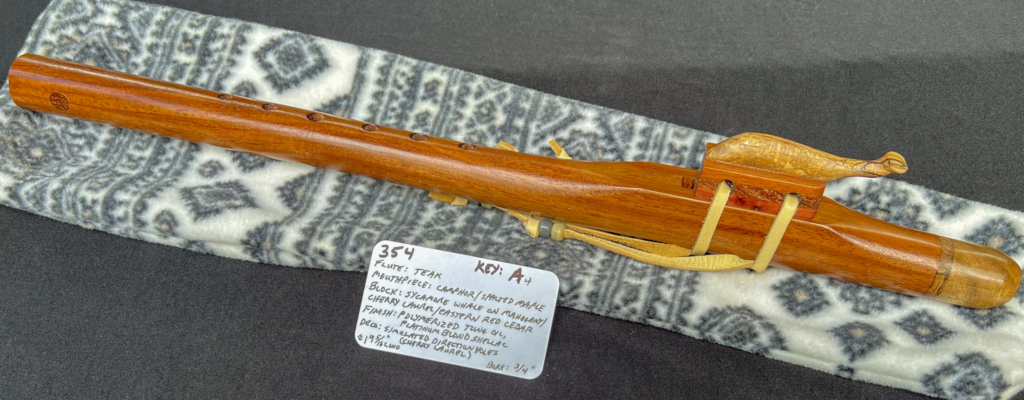
Teak with a Camphor / spalted Maple mouthpiece. Flute # 354 tuned as an A4, is a 3/4″ bore. Simulated direction holes (2) using Cherry Laurel inlay dots are placed on both sides about 1″ above the bore end or foot of the flute. Spalted Sycamore whale carving on the Mahogany / Cherry Laurel / Eastern Red Cedar block.
spalted Sycamore, flute 352
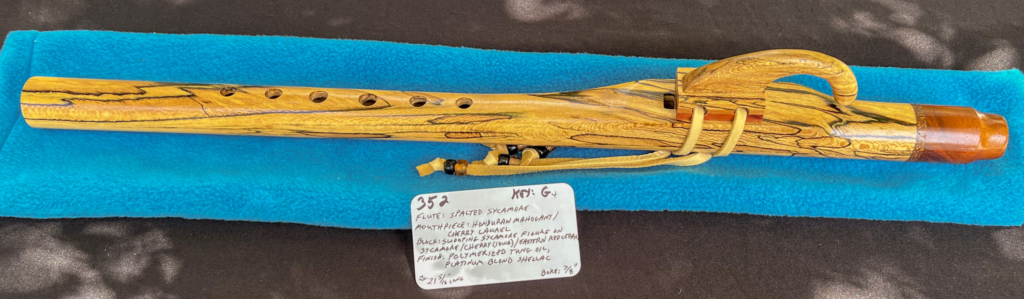
Flute 352 is a 7/8″ bore G4 flute. It is spalted Sycamore with a Honduran Mahogany / Cherry Laurel mouthpiece. The block features a swooping spalted Sycamore figure on Sycamore / Cherry (Iowa) / Eastern Red Cedar.
highly figured Myrtle, flute 337
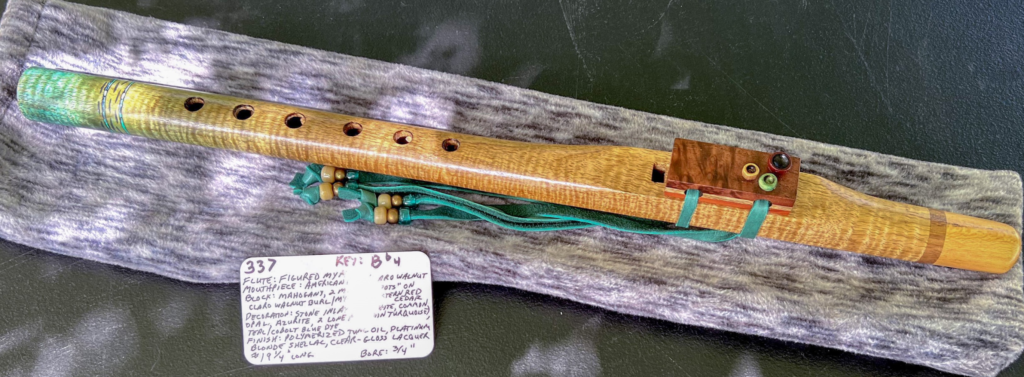
Myrtle (highly figured), Flute 337. The mouthpiece is American Elm and Claro Walnut. The block is Claro Walnut burl / Myrtle / Eastern Red Cedar with one Mahogany and two Myrtle carved “pots.” This flute is tuned to Bb4 (A#). Decorative elements include stone inlay (Malachite, common Opal, Azurite with two Lone Mountain Turquoise nuggets at the bore end. Aniline dyed using Teal and Cobalt Blue colors. The flute has a 3/4″ bore and is about 19 1/4″ long. Finished using polymerized Tung Oil, Platinum Blonde shellac and clear acrylic lacquer. This flute has a particularly bright and joyful voice. A real pleasure to play.
Butternut, flute 333
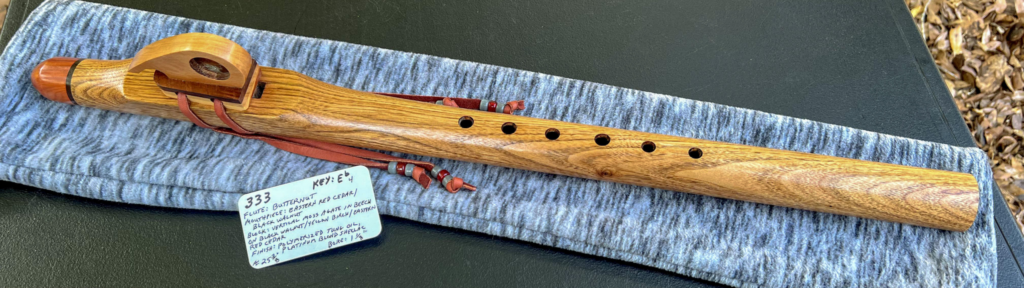
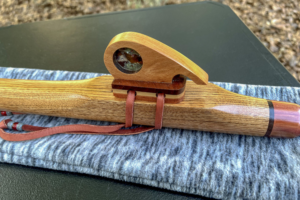
Flute 333 is a 1 1/8″ bore Butternut flute tuned to the key of Eb4 (D#) with a 432 Hz reference point. Equal temperament tuning. The mouthpiece is Eastern Red Cedar (Windsor, FL – felled by Hurricane Irma) / Wild Black Walnut (California). The block features a Moss Agate cabochon vertically mounted in Beech on a base of Black Walnut / Yellow Birch / Eastern Red Cedar. The flute is about 25 3/8″ long. The diameter of the finger holes are only 6.4 to 8.6 mm (0.25 to 0.34″) and the bottom hole is located about 18.6″ (473 mm) from the mouth end of the flute. This thin walled flute (~1/8″ between #3 and #4 holes) really sings!
A polished Moss Agate stone is mounted vertically in Wisconsin Beech on Black Walnut / Yellow Birch / Eastern Red Cedar
Black Limba, flute 307
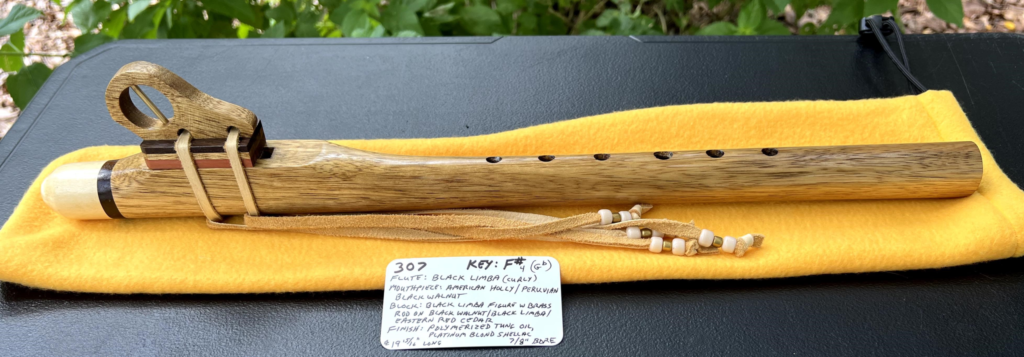
Curly Black Limba with a tenon-mouthpiece of American Holly and Peruvian Black Walnut. The block features a Black Limba figure with an integral brass rod mounted on Black Walnut / Black Limba / Eastern Red Cedar. This 7/8″-bore flute is almost 20″ long and is tuned as an F#4 (Gb).
Black Walnut, flute 286
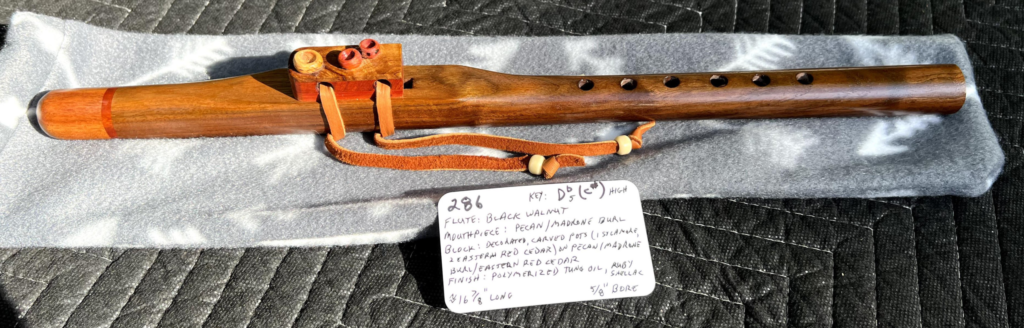
Flute #286 is Chocolate Black Walnut with a Pecan / Madrone burl mouthpiece. The block features pot carvings with wood-burned accents (1 spalted Sycamore, 2 Eastern Red Cedar) on Pecan / Madrone burl / Eastern Red Cedar. The 5/8″ bore flute is tuned to the key of Db5 (C#) – high and is about 16 7/8″ long.
The term “Chocolate” was reportedly used by the loggers who harvested this tree. I don’t think this is a particularly technical term. (smile)
Alaskan Yellow Cedar, flute 215
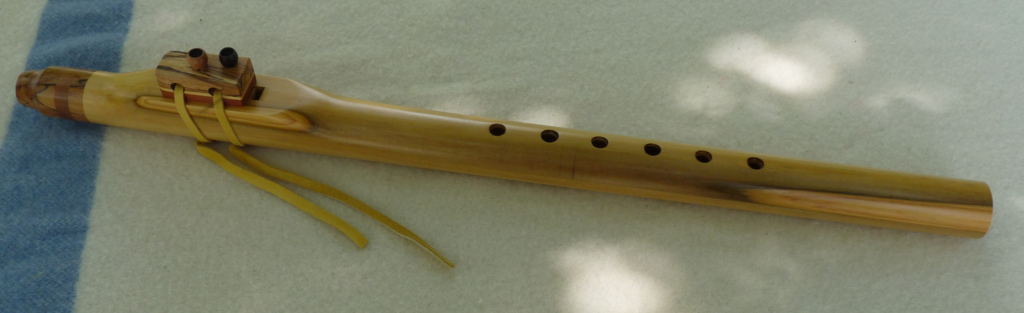
This is Alaskan Yellow Cedar with a mouthpiece of spalted Sycamore and Dogwood. Key of D4. Bore: 1 1/8″. Length 26 1/4″. The block features two carved pots (Dogwood on a Sycamore stand; Masseur Ebony) on a spalted Sycamore / Alaskan Yellow Cedar / Eastern Red Cedar base.
NLSS Flute Firsts
Ray Wood (Island Flutes) gifted me a bamboo blank after learning I had owned three bored blanks a year without doing anything. I had been listening to Ray, Joey Hill and Kuzin Bruce discuss flute making for an hour or so at the Hart Springs Pow-wow (Florida) in 2005. As I recall, as he handed me a heat-treated piece of bamboo and a matching bit intended to serve as the block, Ray said “Any fool can make a flute out of bamboo. I’m going to tell you how!” And so he did.
After a few weeks, I decided I actually might be able to do what Ray described so I got out my new Dremel and started cutting the SAC exit and True Sound holes (TSH) and shaped the bamboo block by sanding. The flute was actually starting to make a pleasant sound when I noticed a white nubbin of something just barely visible peeking through the TSH. Well, I thought. I could clean that up easily enough, so back to the Dremel I went. The next time I tried playing the flute’s fundamental note, it was like blowing through a straw. I’d cut through the bamboo node which makes a flute like this work. I was devastated! I had some ideas about how I might correct the mistake and in fact, I did fix it pretty quickly. But I couldn’t imagine running into any of those flute makers again and being forced to admit, this fool had been incapable of following Ray’s instructions. So, I put it aside.
And turned my attention to working with the first of my three bored blanks. The five-hole, 3/4″-bore, F#4 Black Walnut flute on the left is the result. My first competed flute. The Cocobolo block was supposed to look like an eagle head. I followed that by making a couple of six- flutes using the remaining bored blanks. And completed a couple more using 3/4″ dimensional lumber before asking Joey for constructive criticism. Little did I know, I’d still be completely engaged in flute-making all these years later. I actually warned my new friends they should not be surprised if I moved on to some other interest within 5 years or so. Not that there is anything particularly important about that period of time but merely because as an adult that’s about how long I’d been deeply engaged in other extracurricular activities such as raised-bed, intensive organic gardening. Rose growing, playing golf, riding my Harley-Davidson motorcycle, and so on – one thing after another.
More than 20 years after repairing the node in that bamboo flute, it occurred to me it deserved to be given some finger holes. So, in 2024, I completed the flute I’d started in 2005. It is tuned in key of B4. Sounds pretty good to my ear.
I describe this drone as my “lesson” flute. This one has no maker’s mark. It has a strong sentimental value but falls well short of my standard for a flute that could someday fall into someone else’s hands.
I had many opportunities to learn important lessons while making this one. It is composed of Black Walnut and Eastern Red Cedar. The block has a Circle-of-Life design carved from Ambonya burl. The Black Walnut finger board was a response to correct misplaced finger holes. Six preliminary tuning holes are placed on the back side of the bore end. All were filled in before adding the Black Walnut end cap as a tuning aid. The bores are 5/8″ and the bore length is about 11.” It is tuned as a C4. My preference for avoiding an audible drone effect while opening the bottom finger hole was defined by this project.
What Customers Have Said


★★★★★
Simply Amazing!
You made a real effort to make the whole receiving of the flutes so special! Thank you!!
They are beautifully crafted and all of them sound for me!
★★★★★
LeAnn, 2022
An Unforgettable Experience
The flute is absolutely beautiful. I plan on learning to play it and enjoy it for many years to come.
★★★★★
Matthew, 2008
A Beautifully Crafted Flute
I cannot begin to thank you enough for the beautiful piece of art that is my flute. That it came from you will always make it extra special.
★★★★★
Marian, 2009
Exceptional Quality
I can’t begin to express how much I appreciate this Dan. This flute bag … totally embodies the expert skills you have as a leather worker and artist.
This is without a doubt, THE BEST flute bag that I have ever laid my eyes on brother, and I mean that from the bottom of my heart.
★★★★★
Darrell, 2007